
“To succeed, you must first love the work you are doing, whatever it may be.”
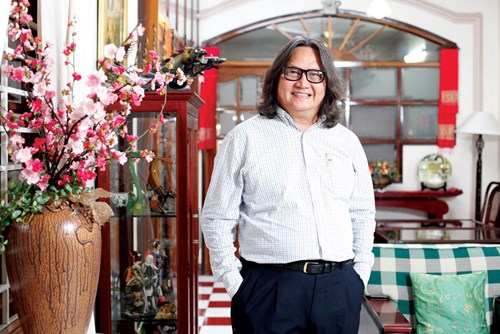 Nguyễn Hữu Chung, Chairman of Nippon Ham Vietnam Foods JSC (Nippon Ham Vietnam) – Photo: Quý Hòa
In 2011, Nippon Meat Packers, part of Japan’s largest food-processing company Nippon Ham Group, acquired an 83% stake in Con Heo Vàng Joint Stock Company. Although the transaction value was not disclosed, Con Heo Vàng’s founder Nguyễn Hữu Chung subsequently became widely known as an entrepreneur who had pioneered the processed-meat market for the 4- and 5-star Horeca sector (hotels, restaurants, and airlines) since 1993.
After returning to Vietnam, I gathered all my savings and went to France to learn how to make meat products. By God’s grace, I was fortunate to meet an excellent teacher who generously passed on many secrets, allowing me to build a “made in Vietnam” Con Heo Vàng.
However, market difficulties during the inflation episodes of 2008 and 2011 truly tested him. His efforts could not save his brainchild, and he went from business owner to employee, retaining only a 17% stake in Nippon Ham Vietnam.
Looking back at what he built over 21 years, he drew just one conclusion: “To succeed, you must first love the work you are doing, whatever it may be.”
* How did you move from partnering with and researching markets for foreign companies into processed foods?
– In 1986, when major packaging companies such as Tetra Park and Alfa Laval (Sweden) began entering Vietnam, I became their partner responsible for domestic market research. Initially, I knew little about food, but through working with many food-related businesses, I realized how fascinating the industry was.
They can make many dishes from pork and beef; they can preserve food in cans and packages… Everything I saw went beyond the meals my mother cooked at home, such as making this dish with beef and that dish with pork…, together with basic knowledge of preserving milk and fruit juice… gained while working with Tetra Park (a company specializing in packaging for milk, fruit juice…).
Gradually, curiosity became a passion that made me think I had to do something for our country's food industry. But I had not yet defined exactly what, until I saw an opportunity in Horeca.
* Did good fortune join your passion, resulting in Con Heo Vàng?
– After studying meat processing in France, a field well developed in Europe, I returned to Vietnam and was fortunate when a French business offered to sell me a food-processing machine that had been displayed at an exhibition, rather than take it back to France.
They agreed to let me pay 30% upfront and the remainder over 3 years. I quickly established Phú Công Minh Company, which owns the Con Heo Vàng brand for products such as ham, sausages, salami and bacon…, with help from the machinery supplier and technical support from a French teacher.
* But 20 years ago, Vietnam's processed-food market was almost entirely foreign products. How did Con Heo Vàng establish itself in that competitive market?
– Compared with foreign companies, we are clearly insignificant. But if Con Heo Vàng gains a foothold, Phú Công Minh will be a pioneering domestic company in this field.
I remember that in 1993, the only foreign premium accommodation service in Ho Chi Minh City was the Saigon Floating Hotel, established in 1989 at Bạch Đằng Wharf and managed by an Australian group. It was always busy.
Later, upscale hotels such as New World, Omni, and Sheraton were built in Ho Chi Minh City one after another. At the time, however, Vissan was the only domestic business supplying processed meat to hotels, and its output was very limited, mainly sausages.
For most of the remaining products, hotels had to import them. At that point, I thought I needed to enter this upscale hotel market quickly, because it was a segment that had been overlooked.
Despite foreign businesses producing tons of goods, Phú Công Minh began production by diversifying its products and prioritizing quality and flavors suited to customers' needs.
For processed foods, hotels also usually have to import full containers; importing smaller quantities by air is very expensive. Con Heo Vàng's products, meanwhile, are supplied locally, offering 80% of the quality at only 70% of the price of imports.
Drawing on this advantage, I developed our services to the fullest, immediately meeting every need of hotels and restaurants. In Vietnam, I know the head chefs of most hotels and regularly meet them to learn what they need. The Con Heo Vàng brand stands for golden quality and service.
* Could you describe the journey of winning high-end customers from Con Heo Vàng's earliest days?
– Our first order came from the New World Hotel: just a few kilograms of sausages and bacon. I still remember the executive chef's surprise when I introduced Con Heo Vàng products. He exclaimed, ‘You make these?’ and asked to visit our workshop.
In food processing, companies' products may look alike, but using them reveals the differences. For example, making good ham first requires selecting a pig that is neither too old nor too young so the meat is fragrant and sweet. Second, choose the leanest and best part of the leg. Third comes the processing procedure.
Ham sold in markets often contains more brine and seasonings. Typically, injecting 1kg of meat with 50% water and seasonings produces 1.3kg. We inject only 15% brine, enough to salt the meat and ensure quality…
Another important point is workshop hygiene, because Westerners put this first. I apply what I learned in France to my own workshop: even if it is small, it must always be clean and sanitary.
I think this, together with the product quality guaranteed by the French teacher who agreed to come to Vietnam to work for me, persuaded the New World Hotel's executive chef to place the first order in 1994 after visiting our workshop.
After New World, we approached the Omni Hotel (now Movenpick). In the restaurant and hotel industry, head chefs know one another and recommend good suppliers to each other.
After two years focusing on high-end hotels in Ho Chi Minh City and establishing a reputation, at the end of 1996 we entered the Hà Nội market, starting with the Melia, Metropole, and Sofitel hotels.
In 2000, resorts such as Ana Mandara, Furama, The Nam Hai, and Six Senses… appeared, and we entered that market too. Beyond the Horeca sector, we expanded our clientele to manufacturing businesses, supplying pork and beef floss to Vinamilk for making baby weaning foods.
We also supply processed meats to fast-food chains such as Lotteria and KFC. Around 8 tons of meat per month have been supplied to Vietnam Air Caterers, which provides meals to international airlines at Tân Sơn Nhất and Nội Bài airports, for more than 15 years.
* With business going so well, why separate Con Heo Vàng from Phú Công Minh?
– Besides manufacturing products under the Con Heo Vàng brand, Phú Công Minh also makes packaging. We separated the Con Heo Vàng brand into Con Heo Vàng Joint Stock Company in 2009, with production facilities in Long An, because we wanted to professionally build a brand specializing in processed meat products.
* Was selling part of your stake in Con Heo Vàng a difficult decision?
– Selling 83% of Con Heo Vàng's shares to Nippon Meat Packers was an unavoidable decision. After separating Con Heo Vàng from Phú Công Minh, we faced the economic recession lasting from 2008 to 2011, which adversely affected our business.
The bank called in the funds because the medium-term loan for building the factory had fallen due. At the same time, inflation struck, and pork prices rose about 68–70% over 3 years. Hotels and restaurants agreed to let us raise prices by only 5–10%, saying they had signed contracts with travel agencies committing to stable prices for the entire year.
Although we tried every way to pool capital and maintain production, the more Con Heo Vàng sold, the more it lost. In 2011, the economy became even tougher, and many businesses struggled, not just Con Heo Vàng. Another reason was that my children did not want to take over their father's business, so I decided to transfer some shares to outsiders.
* Several investment funds reportedly wanted to buy Con Heo Vàng shares. Why did you choose Nippon Meat Packers?
– We chose Nippon Meat Packers because it not only provides financial investment but also helps guide the development of Con Heo Vàng, now Nippon Ham Vietnam.
If the business you established and built faces difficulties and you cannot save it, another business owner needs to take it on so that it can have a brighter future. This is different from seeking funding from investment funds, because that is not a good way to preserve and develop a brand.
* How does Japanese management differ from Nguyễn Hữu Chung's approach?
– Having been trained in Northern European companies, my management style is strongly influenced by them. In particular, I value honesty and transparency. These two qualities help shape people’s working style. After the Japanese partner joined, Nippon Ham Vietnam added criteria to align more closely with Japanese culture.
Management formulas are the same in Asia and Europe. The difference lies in corporate culture. For example, we used to hold regular weekly, monthly, or quarterly meetings. But when Nippon Meat Packers joined, they proposed meeting every day. Each day, the top executive and department heads stand in a line and discuss matters together.
For example: What is new today? What did not go well yesterday? How should we fix it? Then everyone calls out “Let's do our best!” in unison. That is Japanese culture. Regardless of the culture, however, a manager's important task is to encourage employees to think independently and work responsibly. Only then can a strong team take shape.
* What advice from your experience would you share with young people wanting to start in food technology?
– If someone told you to eat a piece of raw meat, would you dare? I have done so to evaluate it, tell customers whether it is good, and truly experience its finest flavors. So this applies not only to food technology: whatever career you choose, you must love it.
As they say in cải lương theater culture, only if you love your craft will its patron bless you. Without love for your work, it is hard to last. For example, in sales, you must love the product you sell. Today, many Vietnamese businesses, after achieving a certain degree of success, hand everything over to others and lose their dedication to the craft.
That is unwise, because only by loving your work can you understand why you succeed and why you fail. In business, a single mistake can destroy an entire brand, hence the saying: ‘A reputation costs thirty thousand to build but sells for three coins.’
* Looking back on your entry into processed foods, what gives you the most to reflect on?
– Nearly 30 years after the country opened up, businesses themselves have grown rapidly but are not yet strong. One could say they have prepared their vehicles; they now need a track and rules of the race to create a strong launchpad for Vietnamese businesses.
The law here must relate not only to domestic matters but also to international ones; only then can businesses soar high and go far. Vietnam has many large businesses but few ‘giants’ in the food industry—only real estate ‘giants.’
Businesses Like Ours Spend Decades Building Toward Future Potential, Yet Just a Few Difficulties Can Leave Us Unable to Survive.
Without an economic downturn, I would need only another 5 years to complete all stages from raw materials through processing, packaging and distribution to the final consumer. After selling part of the business, I realized that with support and a long-term vision, Vietnamese businesses would certainly develop more smoothly.
* Thank you for your interesting insights!
According to Duy Khê
Saigon Entrepreneur
Chương trình liên quan tại YUP Education: The Journey – lộ trình phát triển doanh nhân


