
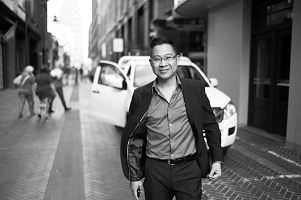
‘Ultimately, failure is merely an outcome that did not go as hoped, and even then it fulfilled my passion. Only losing that passion would be true failure.’ This is the lesson Phở 24 founder Lý Quí Trung drew from the setbacks he experienced while building his business.

After selling the “brainchild” he had painfully brought into the world, Lý Quí Trung, the owner of the Phở 24 brand and a PhD known for his books on franchising, suddenly decided to leave.
One might have thought he had ‘laid down his sword,’ living peacefully abroad with a considerable fortune and a teaching career as an honorary professor at Western Syney University & Griffith University… Yet unexpectedly, he entrepreneurship for the second time with Bon Bistro (BB), a restaurant right on Broadway in Australia. “Fresh, clean, refined, very Vietnamese” are the adjectives Australians have used to describe BB.
A good singer and artist, friendly and elegant—these very “artistic” qualities seem to have helped him go further in business, find interesting lessons even in painful experiences, and write books steeped in experience for later generations, such as: “The Sky Is Not Only Blue”, “Only Passion”…
Having Been Voted by VnExpress Readers as 1 of 50 Influential People Making Breakthrough Contributions to Vietnam, Why Did You Decide to Leave Your Homeland and Settle in Australia?
One of the main reasons I decided to go to Australia was that I wanted my two children to study abroad without being separated from them. I had thought about myself too much, so now that circumstances allowed it, I decided to devote at least 3–4 years fully to my children and family. At the same time, I was fortunate to have arranged my business affairs in Vietnam so I could leave temporarily.
During your time away from home, what troubles you most when you think of your homeland?
I do miss home, but not exactly with regret. Once you choose a new path, you prepare mentally and devote much thought to the future, making the imperfections left in the past seem small.
Having gained a considerable fortune from selling the Phở 24 brand, why did you not enjoy a peaceful life in Australia teaching at Griffith University, instead deciding to start a business a second time with a new restaurant in Sydney?
I had also planned to teach for a peaceful life, but the trouble is, once an entrepreneur, always an entrepreneur! Once you have opened a restaurant, every good location makes you itch to do it again! During those supposedly peaceful years, I always missed the restaurant business, as though a fire were smoldering inside me, waiting to flare up. And then the inevitable happened: I opened another restaurant! It was also convenient because the two children had grown up and were settled.
Having Faced Numerous Failures in Your First Startup, Which Most Costly Failures Gave You Valuable Experience for Your Second Venture and Led You to Write ‘Only Passion’? What Are the 20 Things You Want to Share with Entrepreneurs?
I find every failure costly. Each failure is different, but they all share one thing: they make me stronger. Most failures bear the marks of overconfidence, inexperience, and insufficient planning. The trouble is that if you calculate everything too carefully, you no longer dare to do anything. So I think the skill lies in knowing how to blend a little boldness and a little gray area of uncertainty into systematic planning.
What matters is our attitude toward each failure. Ultimately, failure is merely an unwanted outcome, and it has still served our passion. Only losing that passion is true failure.
Does doing business seem to be a doctorate holder's practical way of ‘questioning himself,’ distilling experience and writing management lessons? Do those two roles ever conflict or even cancel each other out?
I also did not expect business and teaching, or other academic work, to be so closely connected for me. The proof is that when I stopped doing business, I lost much of my inspiration for teaching. When I teach, I do not like to talk much about the past; I prefer discussing the present and my thoughts and plans for the future.
Since opening this restaurant on Broadway, I have felt more energized and wanted to do more. So the two roles you mentioned do not conflict or cancel each other out. On the contrary, they complement each other, just as a lead vocal needs harmonies to sound good!
To remain committed to the difficult ‘restaurant business calling,’ what obstacles did you have to overcome within yourself and in life and business?
In Vietnam, entering the restaurant business was very easy for me because almost my entire extended family had worked in it for years. Australia was entirely different: I had to start from scratch, especially with nobody around. I had to do, learn and research everything myself. The hardest part was understanding the local culture, habits and market characteristics. Knowing is one thing; understanding and mastering them is another. To compete successfully, I must understand customers better than my competitors.
You often speak with young entrepreneurs in Vietnam. In your view, what is the biggest gap in their thinking that prevents startups from going far and lasting? What does a startup need most at the outset?
I see tremendous enthusiasm among young people in Vietnam, which is precious, because not every country's younger generation wants to start businesses so strongly. If I had to identify gaps in their thinking, a few stand out. First, many young people seem too hasty, impatient, and eager to ‘take shortcuts and leap ahead.’ When they see others doing business on a grand scale, they want to do the same. This makes failure more likely, and when they fail, the damage is greater than usual.
Second is the approach to building a brand. When I built my phở chain, I thought only about success in terms of reputation and brand. I never thought of building it to sell or to get rich. If I am not mistaken, many young people make money their goal, which leaves them vulnerable to disappointment and losing their way. Financial benefits will come naturally once entrepreneurs open their hearts and devote themselves fully to what society and the market expect.
What does an entrepreneur need first and foremost? Passion. Do only what you are passionate about, but that is merely a necessary condition. The sufficient conditions: knowledge, a little experience, a little imagination and plenty of luck!
Which consumer trends play a decisive role in a startup’s success or failure? To keep pace with fierce competition amid changing consumer trends, how must businesses and startups apply technology in marketing and customer care?
Global consumption trends probably differ somewhat from Vietnam's particular consumer trends. We must be alert to this when researching the market.
But in general, today’s consumers are far more informed and demanding. They want to know a restaurant’s dishes and prices before visiting. They may even want to know how the food is prepared and what other people think of it.
They no longer trust advertising as before, but only what they discover online themselves. I believe information technology and social media will increasingly determine brands’ destinies.
Looking back at your two entrepreneurial ventures, which traits and qualities helped you withstand storms and recover quickly after each setback? How does starting from zero differ from starting with an existing fortune and reputation in the business world?
I have a very short memory when it comes to failures and always believe that sooner or later I will reach my destination. Clearly, my starting point in Australia is not particularly easy either, although I have more financial breathing room. If an Australian entrepreneur starts out with 100 acquaintances, I now have only a few. In return, however, I possess an immensely valuable wealth of experience, and it will equip me to reach the places I want to go.
Could you tell us a little about your childhood? What made you both practical and romantic?
Romantic or artistic? Generally, I like both, because they make my life more colorful and beautiful. But I also appreciate practicality, because it lets me realize my dreams. I think I was lucky to inherit both artistic and business ‘genes’ from my mother, and romantic and writing genes from my father. In general, both my parents love art, music and beauty.
What is the most precious lesson you learned from your parents' living example? Which family habits and ways of life would you like to preserve for your descendants to build a solid foundation of life values for your children?
Parents and children are very close, even treating one another as friends. Our extended family plays, laughs, and shares pain and joy together. That is the most precious thing I want my children to maintain in the future.
Your mother is also a woman who excels both in business and in music, chess, poetry, and painting. What emotions have her efforts to raise and educate a brood of young children to become successful, through difficult times, left in you? Is there anything you would like to share with hardworking Vietnamese mothers?
My mother sacrificed a great deal for her children. Even after my parents divorced, my mother continued to maintain a good relationship with my father (even though he had a new family), clearly, deep down, so that we would never lack a father's love. I consider that a woman's greatest sacrifice.
Your wife is beautiful and highly capable. How do you keep your home life warm while remaining a sociable, courteous man?
That must be thanks to my exceptionally capable wife! If she weren't so capable, how could I be so sociable and courteous? And I am not just saying that because it is 8/3!
Whenever you return home and see the Phở 24 chain in someone else's hands, how do you feel? Does it sadden you greatly that Phở 24's quality is no longer what it once was, and that Saigon residents are ‘suffering’ over the ‘decline’ of phở?
When handing your brainchild over to someone else, surely everyone wants to see it continue to grow stronger. The person taking it over naturally wants the same. The difficulties and challenges facing Phở 24 are enormous, and I can only hope this ship has the strength to weather the storm.
What do you think about another tycoon preparing to launch a phở restaurant chain called “Phở ông Khải”?
I think the more phở chains and chains serving other Vietnamese dishes emerge, the better. It is good for customers and good for the standing of this dish hailed as a champion.
However, opening several hundred stores in Vietnam requires a highly distinctive, revolutionary, and pioneering business model. Delicious phở alone is not convincing enough because every customer has different tastes, which is why each brand has its own clientele.
The hardest part of opening hundreds of stores may be pricing a bowl of phở competitively while still making a profit. Prices must be affordable, yet profits high enough to expand. In practice, this is far from easy.
What philosophy has helped you stay youthful in both thinking and business?
Life should be joyful. So should business.
How Do You Recover When Your Spirits Are Lowest?
Identify it. Delimit it. Separate it out. Easier said than done, and I am still learning every day. At times, I find that a rich, colorful life helps me stay balanced in such situations. At least I have somewhere to retreat. Painting a picture or playing a song can be effective ways to escape. Sometimes getting through just one dangerous instant brings you into safety, and you have made it through.
How do you train yourself every day to keep your character and soul clear and peaceful amid life's uncertainties?
Find a joy each day. Live fully in whatever you are doing, whether work, sports, or entertainment. I see many people who cannot enjoy themselves 100% even when playing. If we make the effort to look, it seems we can find joy in everything we do.
Collected
>> Great Articles on Entrepreneurship
>> Success Energy Activation Course
>> Business Consulting Program
Chương trình liên quan tại YUP Education: The Journey – lộ trình phát triển doanh nhân


