

Many manufacturers make the mistake of spreading themselves too thin without focus. This pushes up all costs—management, marketing, transport, and customer care—while delivering very little, because fragmented quantities of goods lack the strength to win in any market. Capital recovery is slow and losses are high.
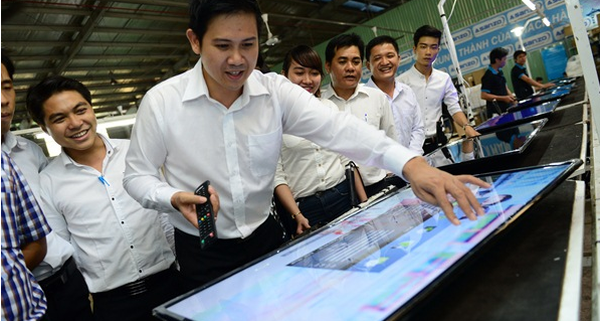
Phạm Văn Tam, Chairman of Asanzo Electronics Joint Stock Company, is known as an entrepreneurial “phenomenon” for achieving impressive growth for made-in-Vietnam televisions in a market crowded with major foreign rivals, particularly in rural areas.
Even more admirable, Tam started his career after only finishing secondary school. Without formal training, the entrepreneur gained business and management knowledge from his own failures.
– Hello, Mr. Tam. Asanzo is considered a startup phenomenon: it has been on the market for just over 3 years but has achieved impressive growth, with revenue in 2016 reaching VND 2500 billion. What is your secret?
– ‘Failure is the mother of success.’ People often see only the successful child, while few know the image of the mother called failure. Asanzo's 3 years of growth are the result of nearly 20 years of my stumbling, mistakes, failures, and starting over.
In my early business days, I did not think of grand ambitions. Simply having a home would have made me happy. My only goal was to earn enough to remain in Saigon. Having left my hometown to build a career, I could not return empty-handed.
Always be realistic, accept setbacks as opportunities to learn and never give up. These are the most basic things that have helped me survive and grow to this day.
– Despite these difficulties, startups continue to flourish among young people in Vietnam. What do you think about this?
– This is an encouraging sign for the economy, especially as the government encourages private-sector development. I believe ‘the more, the merrier’: the more new businesses emerge, the more dynamic and developed the market becomes, bringing more positive value to society.
However, I believe more than 90% of today's startups are off course, overly theoretical and focused on appearances while lacking practical experience, leading to failure.
Many young people are starting businesses as a trend, without clear direction or serious investment in the intellect, abilities and spirit a businessperson needs.
– What are the main causes of this problem, and what is your own solution?
– First, you are straining to become the next Jack Ma, Bill Gates or Mark Zuckerberg… great figures who appear only once among billions of people.
This is a very common mistake among entrepreneurs. Copying successful models is never easy, especially those of the world's exceptional talents who appear only once in billions of people. The odds of matching them may be even lower than winning the lottery.
I think you should stay clear-headed. Rather than mechanically copying unsuitable models of success, develop your own capabilities and combine them with your locality's strengths to address the problems and needs that society truly has.
Second is the task misunderstand the role of technology. We view technology as an intellectual “upgrade,” a new advance for humanity, while overlooking its most important purpose.
The number one purpose of applying technology must be to save time and reduce production, management, and operating costs for businesses, thereby improving efficiency while bringing convenience to customers.
When I first established Asanzo, I dared to invest more than 600 million, though initially hesitant, in an electronic warranty hotline to save printing costs and spare buyers the constant worry of losing their warranty cards.
We can also easily inform customers about new products and promotions using the data they previously provided, which is convenient, economical, and effective.
3rd, you should not always “put your eggs in many baskets”. When starting a business, focus on one product and one market.
Many manufacturers make the mistake of spreading themselves too thin without focus. They think in terms of putting eggs in many baskets, diversifying products, following strong brands, and distributing everywhere. Some even cover all 63 provinces and cities to establish a presence.
This raises every cost, from management and marketing to transportation and care, but delivers very low effectiveness because fragmented quantities of goods cannot win in any market, capital recovery is slow and losses are high.
When I started my business, I made this mistake too and quickly changed. Instead of several dozen small distributors, I concentrated my products with one major distributor, giving them maximum care and support so they could confidently distribute my products.
Low management costs and a lean operating structure help me maximize business performance. This gradually gave me confidence to develop new markets. Starting with just one shop, Asanzo-branded products are now available at more than 6.000 distribution locations, alongside more than 1.000 warranty service stations nationwide.
It is all thanks to the ‘bundle of chopsticks’ strategy: divide the market into smaller segments and conquer each ‘chopstick’ one at a time.
– Do you also apply this ‘bundle of chopsticks’ model in management?
– Building a large, centralized organization in which the leader has to manage every stage is outdated. Instead, I divide the business into independent units.
In each cluster, I work only with the heads of production, management, and business. This is Asanzo's “divide and conquer” method.
Specifically, our management structure has clearly defined levels, with each person assigned their own responsibilities. A department head cannot give orders to, evaluate, or discipline another department's employees, in order to completely eliminate friction and conflict within the organization.
I also often tell my wife, who currently works at Asanzo: ‘At the company, you are simply an employee. Please respect that principle.’
Organizational stability means leaders need less involvement in administration and have more opportunity for creative thinking, market expansion and business development.
– What difficulties did you face starting from nothing without formal training in business management?
– I always think that if I had received a ‘proper’ education, success might have come many years earlier. To achieve what little I have today with Asanzo, I had to pay for my mistakes. Every stumble was a hard-earned lesson I can never forget.
The first lesson concerns the value of trustworthiness in business. In the 2000s, transferring money through individuals was very risky. I lost everything in one such transfer.
At that point, my customers did everything they could to help, because I had always been honest and transparent with customers and partners. They agreed to lend me money to rebuild and continue supplying them.
I learned that in business, credibility is worth more than money. Customers will be your best friends when the business is struggling.
One of the next issues was branding. Initially, I did not understand its importance. Without brand building, my products were quickly pushed out of the market. Once again, I paid for my lesson through failure.
I began figuring out how to build a brand, from distributing flyers and printing advertisements to giving interviews, making business features, and filming televised New Year greetings for customers… Each time, I learned many lessons and gradually achieved encouraging results.
Businesses today must build their brands at all costs. And a strong brand can only come from the internal strength of the business and its products.
At Asanzo, product quality always comes first. Our products use components shared with international brands such as Samsung, LG, and Toshiba, and are assembled through a high-standard process with every unit inspected. As a result, Asanzo electronics offer quality equivalent to international brands on the market.
In particular, when a problem occurs, the manufacturer must accept responsibility and bear the loss. A defective product may be a small matter to us, but for customers it is a major issue involving not only money but also trust in the business and its products.
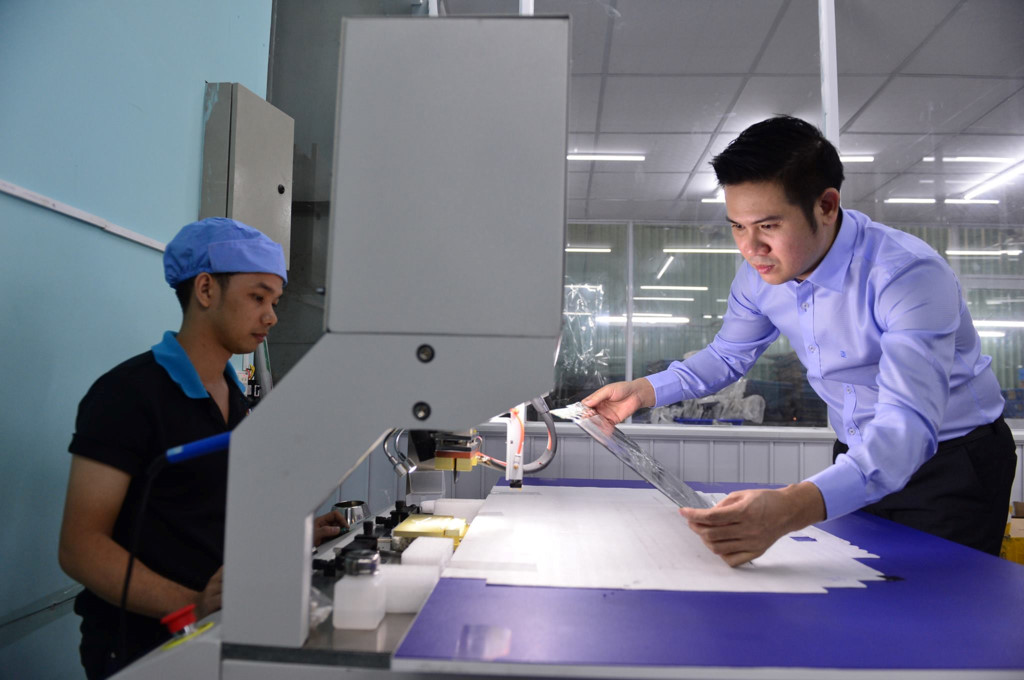
– As a domestic electronics manufacturer, do you feel small when competing with major market players?
– I have never thought of myself as confronting any particular business. The market is vast, and each business has its own strengths and customer group.
Large companies often focus on modern, multifunctional products for premium customers, while Asanzo targets mainstream consumers, workers, and middle-income families.
To make the product accessible to this customer group, we reduced costs by importing components and manufacturing domestically, removing unnecessary functions and focusing on durability and energy efficiency.
We do not compete; we fill narrow gaps in the market, where major manufacturers cannot shrink themselves to meet customers' needs. Products expanded into lower segments and more distant areas instead of concentrating only on affluent central-area families.
– Some say Asanzo has ‘stripped out’ parts of its products to lower prices. How do you feel about that assessment?
– That is not wrong, but not entirely right. We have deliberately ‘reduced’ our products’ features. This is considered the core factor that has kept Asanzo products firmly in the market over the past 3 years.
Knowing that customers would not make much use of complex features, we boldly removed them from our products. Asanzo-style “gutting” does not reduce quality; on the contrary, it makes our products more durable, compact, lightweight and stable.
I applied real-world experience to production and business. I had no idea this was the well-known Sabotage/Removal creativity model distilled by global advertising and creativity master Yohan Dominitz in a talk during his 2016 visit to Vietnam. I had not learned from such famous people, yet ended up applying their very model for success.
– You have been very successful with this model. What is Asanzo’s future development direction?
– This year, we will continue targeting mainstream customers with a more diverse range of new products, such as air conditioners, air coolers, and water purifiers…
In particular, this coming June we will launch a low-cost smartphone range for lower-income customers. This new strategy diversifies our products, strengthens brand value and demonstrates technological development.
We want to bring the world's advanced technology to every Vietnamese person, especially in rural areas, helping improve our customers' quality of life and encouraging the country's development.
Thank you for sharing so sincerely, and wishing you and Asanzo even greater success.
Chương trình liên quan tại YUP Education: X-Startup – khóa học khởi nghiệp «Khởi Chánh Nghiệp» · The Journey – lộ trình phát triển doanh nhân


