
Many factors influence starting a business of yours. Whether starting a business is easy or difficult, a complete business plan will take you halfway there.

When starting a business, you must clearly define your business goals and purpose. The best approach is to have a complete business plan explaining how you will conduct the business, including capital, staffing and economic assessments, as well as an outline of the upcoming operations.
Why Must Starting a Business Begin with a Plan?
As a young business, a business plan will help you:
– Find investors
– Borrow from a bank
– Improve the current business environment
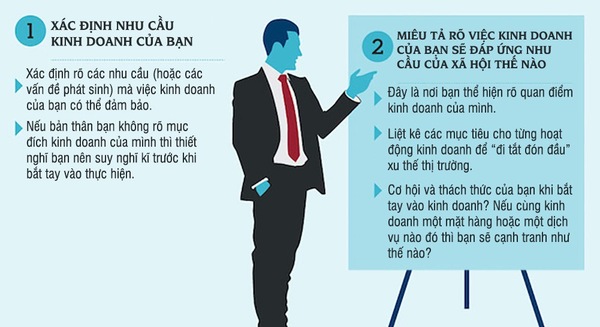
1/ Clearly Identify Your Business Needs
– Clearly identify the needs, or emerging problems, that your business can address.
– If you are not clear about your purpose in business, I think you should carefully consider it before getting started.
2/ Clearly describe how your business startup will meet society's needs
– This is where you clearly express your business perspective.
– List objectives for each business activity to anticipate and get ahead of market trends
– What opportunities and challenges do you face when starting a business? If you sell the same product or service as others, how will you compete?
3/ Clearly identify your competitive advantage
– Create a detailed outline of your advantages when starting starting a business, to reaffirm that your business will “survive.”
– Clearly identify the advantages and challenges of competing with others.
– Set yourself apart from the crowd and demonstrate that you possess what others do not.
– 36% of surveyed business owners received investment with their business plans
– Only 18% happened to receive investment without a business plan
4/ Identify key personnel
– Clearly state each person’s strengths
– Find and define positions for key personnel: managers, advisers, and so on.
5/ Identify potential markets
– Analyze your potential market: whether it is large or small, strategies for market expansion and development, and potential profits.
6/ Clearly identify potential customers
– Khi starting a business, you need a marketing strategy suited to each market and customer group
– Otherwise, you are simply wasting your money and time.
7/ Develop ideal PR and advertising campaigns
– How do you reach customers and gain a grasp of the market?
– The PR and advertising plan should include ideal channels to appeal to customers’ tastes and provide places where they can read information about your business
8/ Develop ideal PR and advertising campaigns
This work includes: Unit Cost, Expenses, Profit, and Budget
Profit forecasts are often inaccurate but help you understand the value of your business operations
9/ Capital – Planning and practice
– You can raise capital from friends and relatives
– If starting a business small, you should carefully consider taking a bank loan
– Ideally, find an investor for your business.
10/ Always Have a Backup Plan for Situations
– Profit starting a business is difficult to predict, but you can still prepare several contingency plans and “push” sales to generate profit.
– Implement the plans month by month and during the first two years of business.
>>> 64% of surveyed business owners said contingency plans are their “lifeline” and generate profit
>>> 43% of businesses do not have a similar answer
Thụy Dương
According to Trí Thức Trẻ
Infographic from cafebiz
Read more:
Starting a small business – A 7-step marketing plan
An entrepreneur born in the 1980s starts a small business with VND 1 million
Chương trình liên quan tại YUP Education: X-Startup – khóa học khởi nghiệp «Khởi Chánh Nghiệp» · The Journey – lộ trình phát triển doanh nhân


