

In late 2016, a series of world-renowned publications, including the New York Times, Bloomberg, and Nikkei, praised Vietnam as the producer of the world's best chocolate. It was Marou chocolate, founded by Samuel Maruta and Vincent Mourou.
‘This is the best chocolate you have never tasted,’ The New York Times commented. Producing those delicious chocolate bars depends on high-quality cacao beans. According to Marou's founders, Vietnamese cacao is every bit as good as cacao grown in Brazil, Russia, or Côte d'Ivoire.
When Marou entered its Tiền Giang chocolate in a competition, it won a silver medal in the “best bean-to-bar dark chocolate” category (chocolate made from the cocoa bean all the way to the finished bar). Marou's 78% Bến Tre chocolate also won bronze. This shows that areas capable of growing high-quality cocoa in Vietnam are not rare. Marou itself names its 5 chocolate varieties after the 5 provinces supplying its cocoa beans: Tiền Giang, Đồng Nai, Lâm Đồng, Bà Rịa – Vũng Tàu and Bến Tre.
Even so, Marou's remarkable story has not, in reality, been able to transform the lives of many Vietnamese cacao farmers. Although recognized as one of the world's most suitable places to grow cacao, cacao beans are still far from common in our country, with output accounting for only 0.1% of global cacao production. Farmers also choose cacao only after many other crops, such as coffee, pepper, and cashews.
In 2015, not far from Marou’s cacao purchasing point, also in Tiền Giang Province, the Chợ Gạo Cacao Marketing Cooperative had once been farmers’ hope for a market for their beans. But iron doors, rusty locks and cacao fermentation machines never used even once revealed a sad reality: cacao farming here was dying.
Farmers here say cocoa prices are very unstable. Fresh cocoa beans sell for around 2,200 dong/kg, but at times the price has fallen to just 800 dong/kg. Discouraged by low prices and difficulty finding buyers, farmers have had to cut down cocoa trees that were many years old for firewood. Gradually, the large Chợ Gạo cooperative, which once had 500 members, was left with only 15 members struggling to hold on.
Seeing cocoa trees being cut down one by one deeply troubled Bùi Durassamy (Samy), a Vietnamese Canadian of Vietnamese and Indian heritage. Mr. Samy bears his mother's surname, Bùi; his father was of Indian origin, and he was born in Saigon in 1951. Returning to Vietnam at age 65, he bought a plot of land in Tiền Giang, intending to rest and enjoy his later years. But when he visited a cocoa-growing area, he felt he needed to do something to help the farmers there.
‘As soon as I returned to Vietnam, I saw how much farmers were suffering. They grew crops they could not sell and were forced to accept very low prices. Seeing their plight, I made no promises; I simply said that if everything went well, I would purchase cacao at its true value,’ Samy shared in very fluent Vietnamese.
His sun-darkened skin, gray hair and wrinkles at the corners of his eyes bear witness to Samy’s 40 years of hard work in Canada. Yet as soon as he returned to Vietnam, his retirement plans were put on hold. Instead, he climbed onto an old motorbike and traveled Tiền Giang’s roads to observe farmers’ methods and find markets for cacao.
While pondering the matter, Mr. Samy was astonished to see international media praising the world's finest chocolate made from cacao beans grown by Vietnamese farmers themselves. He was even more surprised to hear cacao farmers approaching 70 or 80 say they had never tasted chocolate.
Having studied food processing at university and owned a mechanical-engineering company, Samy understood the basic process of turning cocoa into chocolate. He therefore planned to build a chocolate factory that would buy farmers’ cocoa beans and create Vietnamese-made chocolate by Vietnamese people. With just 7 billion dong originally intended for retirement, the ‘chocolate old man’ officially began his entrepreneurial journey in his sixties.
Samy's first challenge, like that of any entrepreneur, was knowledge. Although he knew the basic process of turning cocoa into chocolate, he still had to go through arduous experimentation to achieve the result he wanted.
Chocolate production can be roughly summarized in 12 basic steps: harvesting cacao pods, fermenting beans, drying and storing beans, testing and cleaning them, roasting, cracking and winnowing, obtaining the nibs and grinding them into cacao paste. To make chocolate, the next steps are mixing, refining as finely as possible, tempering, molding and finally packaging. For cacao powder, the paste is pressed into cakes, then finely ground, sifted into powder and packaged.
Chocolate making involves two crucial stages. First, farmers must ferment cocoa beans correctly, for the right number of days and hours and at the right temperature, to ensure quality. Second, grinding at the factory requires specialized machinery.
In the early cocoa-bean investigations, Samy found it easy to locate and buy cocoa from growers because raw materials were plentiful. Producing beans of sufficient quality was another matter. Cocoa beans are generally dried and fermented naturally in sunlight, gradually changing from their fresh color to brown during fermentation.
‘Weather has the greatest impact on fermentation. At certain points in the harvest season, it rains continuously for many days, even though cocoa beans must be placed in the sun within six days of harvest. In such rain, the beans over-ferment and no longer have sufficient quality for making chocolate,’ Mr. Samy said.
After fermentation comes grinding the cacao nibs at the factory. According to Samy, this is the most complex stage, costing him many sleepless nights. Chocolate-making machines are uncommon in Vietnam because few people use them. He traveled from North to South, to Bình Dương and Thủ Đức, searching for equipment but could not find suitable machines.
With no other option, Mr. Samy drew on his knowledge as a mechanic who had worked for Boeing to study how chocolate-making machines operate. He created his own designs, then visited machine shops to buy machines or parts to assemble and build his own chocolate-making equipment. According to him, as much as 80% of the machinery in his current chocolate workshop was made by him.
However, designing and building the machine took a great deal of time because domestic workshops were too rudimentary to turn or drill precise holes, or refused to make special components not mass-produced in Vietnam.
The specialized machine for separating cocoa shells from the beans alone took him nearly 4 months of work. Once, he smashed the machine after taking it apart, reassembling it, and adjusting the airflow dozens of times without achieving the result he wanted.
Mounting difficulties seemed likely to halt the Vietnamese-Indian man's desire to make chocolate. Sometimes, when completely stuck, he did not know what else to do but run into the street and shout.
Self-directed exploration, persistent production and testing continually swept Samy along. He even sold his Canadian workshop to fund the venture. It took nearly 2 full years of development in Tiền Giang before he produced his first successful batch of chocolate.
“I jumped up and shouted with joy when the first batch of chocolate turned out exactly as I wanted. My assistants and I yelled at the top of our lungs: We did it, we did it! I was overjoyed,” the man in his sixties recalled with a broad smile as he looked back on that memorable moment.

The First Thing He Did After Successfully Making His First Batch of Chocolate Was Give It to the Farmers Who Grew the Cocoa.
“Farmers do not yet recognize the value of the trees they cut down every day. Letting them taste chocolate is one way to help them understand what can be made from cacao. I want them to understand that the cacao they grow can be refined into excellent chocolate,” he said.
After successfully developing chocolate, Mr. Samy focused on expanding production. A factory covering more than 1ha opened in January 2017 in Tiền Giang Province under the name Kimmy's Chocolate. The Kimmy's brand was named after his wife, Kim Nguyệt. “Abroad, people can't pronounce Nguyệt clearly, so they usually call her Mrs. Kim. When I returned home to make chocolate, my wife was also the strongest opponent, so I wanted to do something as a gift for her,” Mr. Samy shared.
More importantly, after its founding, Kimmy’s Chocolate voluntarily joined the Chợ Gạo Cooperative as an official member and purchased farmers’ cacao for production. Samy’s wish to find a market for cacao growers gradually became reality as the cooperative, once facing dissolution, revived strongly. His Tiền Giang factory now produces around 100 kg of chocolate daily and 3 tonnes of finished products monthly.
Although production is still only at the stage of gradually getting acquainted with the market, supplies from Chợ Gạo are already insufficient, since only 60-65% of each kilogram of beans yields material for chocolate. However, Mr. Samy says he will wait for farmers to gradually expand the growing area. What he still wants is for his chocolate to be made from cocoa beans grown on his own homeland's soil.
“I am not worried, because the quality of Tiền Giang cocoa is every bit as good as imported products from other renowned countries,” Mr. Samy said as he broke a chocolate bar. He explained that good chocolate contains nothing but chocolate, sugar, and milk. It should melt automatically in the mouth without feeling gritty. In addition, a chocolate bar should make a crisp snap when broken.
To promote its products and expand distribution channels, Kimmy’s introduces them to Vietnamese consumers through trade fairs in Cần Thơ and Ho Chi Minh City. Kimmy’s currently has 4 chocolate products with cocoa percentages of 75%, 65%, 55% and 45%, corresponding to dark chocolate, milk chocolate and filled chocolate,… To expand its market, Kimmy’s will soon introduce a 35% variety suited to children’s tastes and lower-priced mixed products.
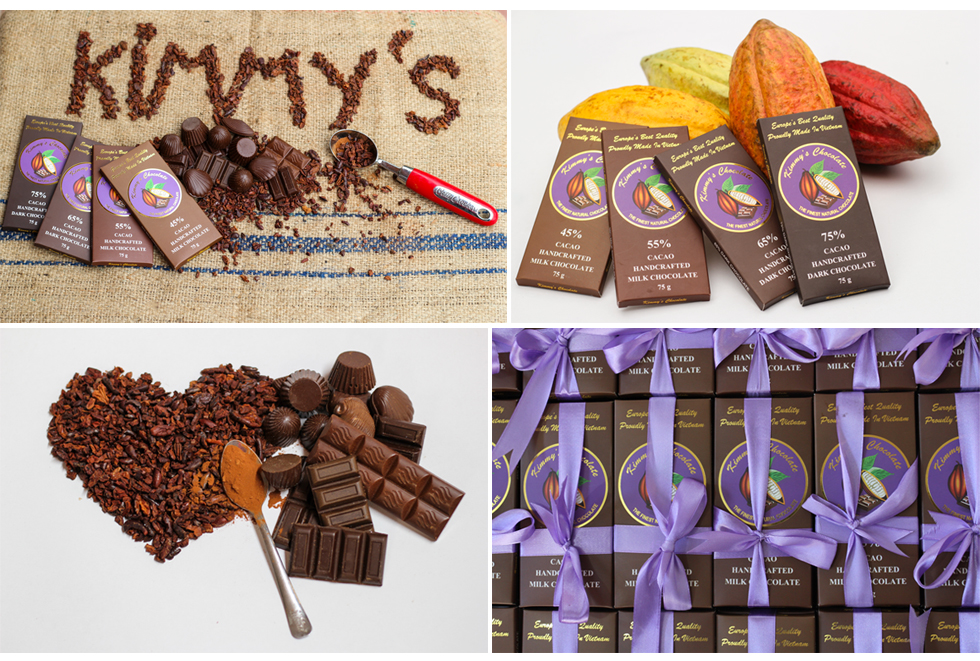
For a newly established brand, difficulties arising from limited distribution channels are inevitable. But good news travels, and the “chocolate old man's” Kimmy’s brand has begun to become known.
“Many partners have already placed chocolate orders. In the near future, Kimmy's will sell its products through a French retail chain in Ho Chi Minh City and Hanoi. We will also soon introduce cocoa powder for baking and cocoa-based cosmetic products,” said Phạm Đình Ngãi, Deputy Director of Kimmy's.
Still very young and formerly a teacher, Ngãi was drawn to Samy's intense passion and volunteered as his assistant. Together, they endured hard times. ‘If you come here later and can no longer find me, just look for him,’ the elderly man said, pointing to Ngãi as the next generation's successor.
Watching foreigners taste and praise European-standard chocolate bars labeled ‘Proudly made in Vietnam’ at the fair, Samy could not help smiling with pride. The owner of Kimmy’s chocolate hopes that, in the not-too-distant future, tourists will buy chocolate in Vietnam to take home as gifts.
Chương trình liên quan tại YUP Education: X-Startup – khóa học khởi nghiệp «Khởi Chánh Nghiệp» · The Journey – lộ trình phát triển doanh nhân


