

With nearly USD 300 million earned from his previous startup, Telegram's founder continues to fund his app out of his own pocket.
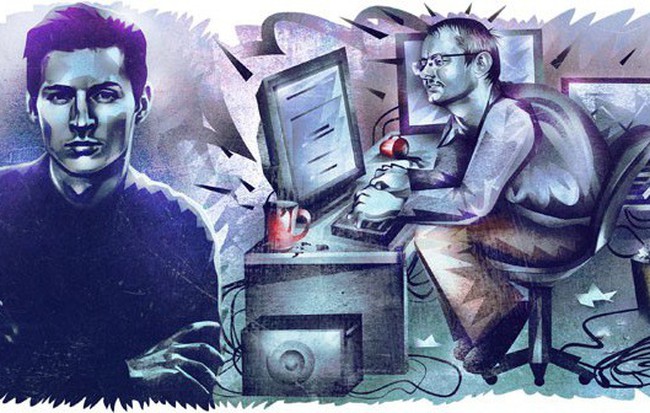
In 3/2016, Pavel Durov, founder of the Telegram messaging app, declared confidently at a technology conference that the app had attracted 100 million monthly users and around 350.000 new followers each day.
This is indeed an extremely impressive figure, but even more impressive is that Telegram did not raise capital conventionally. Its founder wanted it to operate like Wikipedia, asking the community to donate money to maintain the service.
The two founding brothers are “coding geniuses”
Even in childhood, Pavel Duvov had some run-ins with authority. While at school, Pavel used his innate coding genius to hack the school's computer network. He changed the welcome screen to ‘Must Die’ beside a picture of the teacher he hated most. The school retaliated by cutting off his access to the internal network. Yet Pavel kept hacking and obtaining the new passwords.
Pavel told his classmates he wanted to become an “internet icon,” Nikolai Konovov said in his book about code, The Durov Code. Nikolai is Pavel’s older brother, who helped him realize that ambition.
Nikolai himself was a genius from a very young age. He read extensively and won twice consecutively in 2 seasons of an international programming competition. “He is a computer genius,” said Internet entrepreneur Anton Nossik, who had known Durov's older brother for many years. In interviews, Pavel often refers to his brother as his primary role model and programming adviser.
Pavel founded Vkontakte upon graduating from St. Petersburg University in 2006, initially designing it as a social networking platform for students.
Nikolai initially advised his younger brother by telephone because he was living in Germany at the time. However, once VK gained a foothold, he returned to St. Petersburg and became the company’s Chief Technology Officer. It became a social network rivaling Facebook in Russia and even operated faster than its competitor.
However, VK later encountered problems with the government, forcing Pavel to sell all his shares, lose his job, and leave his homeland. He resolved to create an ultra-secure messaging app to “retaliate” against the Russian government. Telegram was born.
Spending USD 1 million of his own money each month to keep Telegram operating
According to Pavel, he earned around 260 million USD from VK. With that money in a Danish bank, Durov and his brother Nikolai began rebuilding their careers. They purchased citizenship passports from the Caribbean island of St. Kitts, then devoted themselves to their new company, Telegram.
The project was inspired by the secure encrypted messaging system Durov and his brother used to communicate without being monitored. By packaging everything into an app, Durov brought the world a leading secure messaging method. Telegram was released in 8/2013 without an official announcement.
Because of his troubles with the Russian authorities, Pavel's management style is somewhat “secretive” to avoid surveillance. He uses as many as 3 different phone numbers but rarely discusses work by phone. Telegram was developed in a small office in Berlin. Now, however, its employees work in various locations, mostly booking accommodation through Airbnb.com and moving constantly.
Explaining this, Durov said it would keep the company from becoming entangled in any country's politics or economy.
Telegram is not for sale, nor is it a place for investors. Durov said many prominent Silicon Valley venture capital firms had approached him with countless attractive offers. But Pavel said he only wanted to build a small, close-knit team.
According to BI, Telegram also ‘consumes’ USD 1 million of Durov's money each month without yet generating any income for him, but Pavel considers this ‘still under control.’ Of course, Pavel says this cannot continue forever.
He said he was exploring ways to generate income for the company by allowing developers to build services on Telegram's platform and taking a commission on the profits.
Collected.
>> Great Articles on Entrepreneurship


