

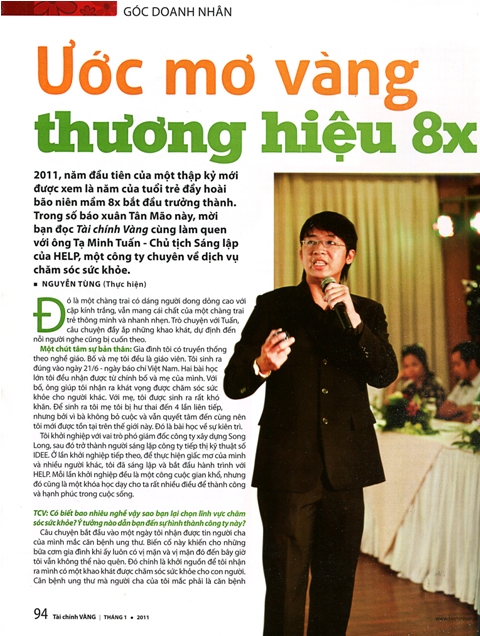
2011, the first year of a new decade, is seen as the year when the ambitious young 8X generation begins to mature. In this Tân Mão Lunar New Year issue, we invite Tài chính Vàng readers to meet Mr. Tạ Minh Tuấn, Founding Chairman of HELP International Corporation, a company specializing in healthcare services.
He is a tall, slender young man with clear glasses, still carrying the air of an intelligent, quick-witted youth. Talking with Tuấn, one hears so many aspirations and plans that the listener is swept along.
A few personal reflections
My family has a teaching tradition. Both my parents are teachers. I was born on 21/6, Vietnam's Press Day. I learned two major lessons directly from my parents. My father helped me discover my desire to care for others' health. With my mother, my birth was very difficult. Before having me, she suffered 4 consecutive miscarriages, but because she did not give up and remained determined to the end, I came to exist in this world. That is the lesson of perseverance.
I began my entrepreneurial journey as deputy director of Song Long Construction Company, then became the founder of the digital marketing company IDEE. In my next venture, to realize my own dream and those of many others, I founded HELP and began that journey. Every venture is a difficult undertaking, but it is also a course that teaches us a great deal about achieving success and happiness in life.
TCV: With so many professions available, why did you choose healthcare? What idea led you to establish this company?
The story began one day when I learned that my father had cancer. This event made our family meals taste salty, a taste I still cannot forget. It was the beginning of my realization that I had a desire to care for people's health. My father's cancer was a chronic disease that developed over time as a result of lifestyle, and such diseases can be prevented. In particular, seeing my father gradually recover and become healthy because he remained optimistic and had a
a healthy lifestyle, the more I understand the importance of lifestyle.
The idea of a personal doctor service, a concept close to family medicine, emerged. Personal doctors can monitor clients' health, advise on lifestyle design and help prevent illness. They can store clients' lifelong health records, understand their biological characteristics thoroughly, and visit their homes for examinations, treatment and preventive advice, like a family member. When needed, they bring nurses to provide personalized care and conduct tests at home. Such a service offers convenience and attention while helping educate and raise awareness of preventive medicine in Vietnam.
TVC: And what did you do to put that idea into practice?
Once determined to pursue this idea, the first thing I did was assess my existing resources. I looked through my contacts and chose the most suitable people, then spent a month sharing my idea, with the goal of telling at least one person every day. I knocked on doors and followed each opportunity. Sharing the idea this way brought me a great deal of feedback to refine both the concept and the plan. After a month, I found people willing to join me, and we formed a team.
My family has a teaching tradition rather than a business tradition, so children wanting to do business must take responsibility themselves. When I started, I received no financial support, experience, or resources from my family, mainly moral support. I had just 5 million đồng left to begin everything. With no money to pay staff, I could not hire full-time employees, so I had to find suitable people and persuade them to work with me without pay at first. Although unpaid, we worked effectively like a real business, systematically undertaking everything from qualitative and quantitative market research to information systems, business strategy, staffing plans, financial plans, and other work systems. We were doing many things for the first time, but learned through our experience as we went.
TVC: You are surrounded by a very professional and seasoned team. What is your secret to persuading these people to get on board with you?
To find good collaborators, first remember that they work with you, not for you. Train yourself to be a leader rather than a boss. Treat collaborators with both respect and care. Invite people who share your dream aboard, because they want to fight alongside you. Sincerity is vital: you must truly want to work alongside them and succeed together. Work with people better than you, because nobody excels at everything. Put simply, suppose realizing your dream requires excellence in 5 specialties, each needing 10 years of experience to master. You would need 50 years before you could begin. Instead, work with 5 experts, each with over 10 years of accumulated experience, and you immediately have 50 years of experience as capital for realizing your dream. Always listen—that is the secret to leading alongside strong-willed people.
TCV: Capital for a company is 1 major issue. From what sources did you raise that capital, and could you share this with TCV?
Capital is certainly necessary for starting a business, but it is not sufficient on its own. When you begin a business, you need to raise funds from every possible source. HELP raises capital from investment funds and individual investors. To raise funds successfully, you must demonstrate that your business model is viable. For HELP, there is another factor: it seeks investors who care and want to contribute to the community. When you find the right investor, resources from money to effort converge toward a shared goal, giving your team tremendous strength.
One thing to consider is which should come first: money or talented people? Talented people to make more money, or more money to hire talented people? Similarly, should you raise investment first and use it to recruit talent, or first build a talented team and then persuade investors to fund your project? The answer depends on the situation. Money can buy a person's ‘hands’ and ‘mind,’ but not their ‘heart.’ For investors in startups, what they are truly investing in is not your idea, but people.
TCV: What goals does HELP pursue?
HELP’s vision is to become a group caring for Vietnamese people’s health, both physical and mental. Its members are working with all their strength toward that goal.
TCV: What do you think of young people your age? Is making money their goal?
Today's 8x generation is very dynamic. Yet perhaps we still do not truly have a generation that “dares to dream.” Many young people do not know what they really want, what their dreams are, what direction to take, or which path to choose, and have not answered the most important question: “What is my purpose in life?” Those with dreams often lack the belief to pursue them, so they still do not act, leaving their dreams as mere wishes. In my view, the fault lies not with young people but with education. Education's mission is to help people identify their dreams, believe they can achieve them, and acquire the skills needed to act. Once you have a sound dream, making money is not your ultimate goal; it is a result that follows other achievements, such as bringing value to society.
TCV: What is your favorite saying?
It is Steve Jobs's saying, ‘Stay hungry, stay foolish’ (Stay hungry, stay foolish). Jobs was Apple's founder and CEO. I deeply admire his talent and the path he took, including his tireless battle with cancer while creating new value for the world.
TCV: Is there anything else you would like to share with TCV readers at the start of the Tân Mão Lunar New Year?
The final thing I want to share is also our philosophy of life, expressed in the very name HELP: The happiest person is the one who helps the most people. Life is very short, which is why we need to help others and live as meaningfully as possible.
Thank you sincerely!
Produced by Nguyễn Tùng
Tài Chính Vàng, month 1, 2011


